End of the Road for Tees Flex as Transport Chiefs Admit Service Was Not Viable
- Feb 25
- 2 min read
Tees Flex Axed After Multi-Million Pound Experiment Fails to Deliver
25th Feb 2026
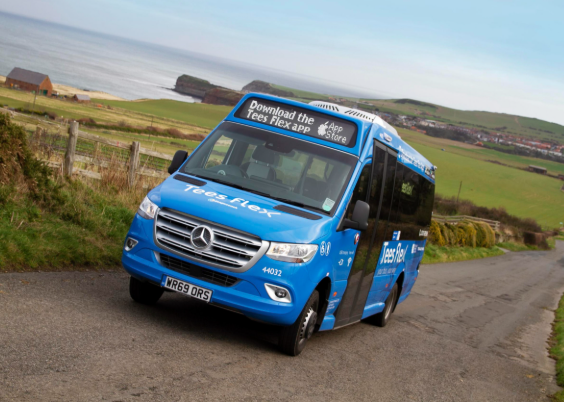
The Tees Valley’s flagship on-demand bus service is to be scrapped at the end of March, bringing an end to a high-profile multi million pound transport experiment that was once promoted as a flexible solution for communities with limited public transport.
Tees Flex, which allowed passengers to book journeys via an app or by phone rather than relying on fixed routes and timetables, will be withdrawn from the supported bus network following a decision by the Tees Valley Combined Authority Cabinet. In its place, a series of conventional bus services will be introduced to cover the areas where demand has been highest.
The decision follows whats claimed to have been 'a sustained decline in use', as well as mounting concerns over the long-term cost of operating the service. Evidence which is set to be presented to transport leaders makes clear that the model struggled to work in the geography of the Tees Valley, where relatively low population density meant passengers were often travelling in different directions at different times, making it difficult to group journeys efficiently. Operators said that as demand grew, the Tees Flex service became harder — and more expensive — to run effectively. The fixed cost of the contract meant additional vehicles could not be deployed without driving the subsidy per passenger even higher, while the need to pre-book trips reduced confidence among commuters who rely on guaranteed arrival times for work and education.
The report also confirms that the expansion of traditional bus routes in rural and semi-rural areas over the past two years had effectively drawn passengers away from Tees Flex. New and improved fixed services offered a level of certainty that the on-demand model simply couldn't match, particularly for regular travellers.

Transport chiefs have now moved to retain what they describe as “essential connectivity” by introducing new fixed routes based on actual travel patterns. Among the replacement services will be a route linking Dalton Piercy and Elwick with Hartlepool town centre and the railway station, along with connections to major supermarkets and Hartlepool Sixth Form College. Further changes will see new links created between villages such as Redmarshall, Stillington and Bishopton and key destinations including North Tees Hospital and Stockton High Street, while an extended Darlington service will operate in a loop through a number of outlying communities. In total, its said that the replacement network represents a commitment of around £1 million pounds from the region’s future bus funding allocation.
The end of Tees Flex Service marks a significant shift in the areas transport policy. When it was launched, demand-responsive travel was presented as a modern, technology-driven alternative to traditional bus services, particularly for areas where conventional routes were considered uneconomic. Its withdrawal is an implicit acknowledgement that, in the Tees Valley at least, its been revealed that the model simply couldn't deliver a cost-effective or reliable service at the scale required.